Key takeaways from the report
Two investors can put the same dollars into the same building and have very different experiences, depending on where they sit in the capital stack.
The senior lender provides a construction loan secured by the property.
Preferred investors typically receive a fixed or targeted preferred return and get their capital back before common equity, but their upside is capped.
Why the capital stack matters
Two investors can put the same dollars into the same building and have very different experiences, depending on where they sit in the capital stack. Your position determines when you are paid, how much you can earn, what protections you have and what risks you bear. Understanding the stack is the first step to reading any private real estate offering.
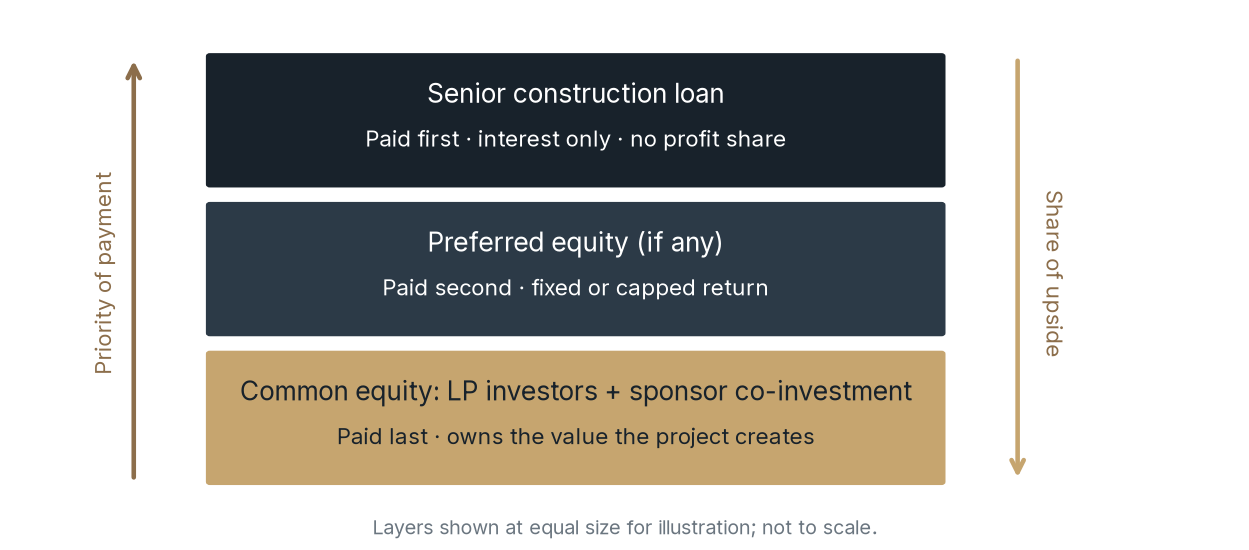
Chart Summary and Key Values
Illustrative capital stack: the senior construction loan is paid first, with interest and no profit share; preferred equity, if present, is paid second with a fixed or capped return; and common equity, including LP investors and sponsor co-investment, is paid last and owns residual value. The equal-sized layers are not an allocation of actual project capital.
The capital stack, from first-paid to last-paid. Layers shown at equal size for illustration; not to scale. Graphic: Ascendant Development.
The layers, from top to bottom
Senior construction loan
The senior lender provides a construction loan secured by the property. It has first priority on cash flow and on proceeds from a sale or refinance. In exchange for that priority, the lender receives interest but no share of the profit. Lenders also impose controls: budgets, draw processes, inspections and third- party cost review.
Preferred equity
Preferred equity sits below the loan and above common equity. Preferred investors typically receive a fixed or targeted preferred return and get their capital back before common equity, but their upside is capped. Not every project uses preferred equity; when it does, the terms are disclosed in the offering documents.
Common equity
Common equity is the ownership layer. It receives distributions after the loan and any preferred equity are paid, and it owns the value created by the project once those positions are satisfied. That is where the economics of development show up: if a project is built at a cost below its stabilized value, the gap accrues to common equity.
LP investors in a sponsor's offering typically hold common equity.
Sponsor co-investment
Strong sponsors invest their own capital in the common equity alongside their LPs. That co-investment puts the sponsor in the same position as investors, which aligns decision-making.
Reserves: the cushion inside the stack
Reserves are cash set aside at closing for specific purposes. In development, the most important is the interest reserve, which covers interest on the construction loan while the property is being built and leased, before rental income can carry those costs.
A fully funded interest reserve, sized conservatively for a longer construction and lease-up period than expected, means the project does not depend on new capital from investors if the schedule slips. Other common reserves include a construction contingency (for cost overruns) and operating reserves for lease-up.
When you review an offering, ask how each reserve is sized and what scenario it is designed to cover.
How money flows: the distribution waterfall
The waterfall describes the order of payments once the property generates cash or is sold:
1. Operating expenses are paid.
2. The senior loan is paid.
3. Preferred equity, if any, receives its return and capital.
4. Common equity receives its capital back and a preferred return, if the agreement provides one.
5. Remaining profits are split between LPs and the sponsor according to the agreement, often with a larger share to the sponsor above certain hurdles (sometimes called the promote or carried interest).
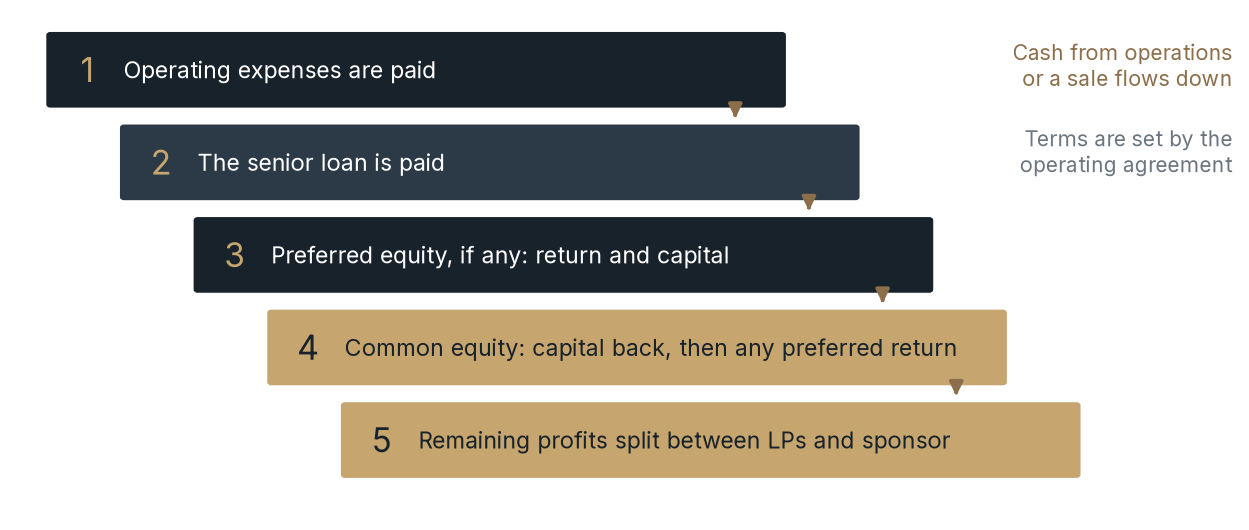
Chart Summary and Key Values
The illustrative five-stage payment waterfall pays operating expenses first, then the senior loan, then preferred equity return and capital if present, then common equity capital and any preferred return, and finally remaining profits split between LPs and the sponsor. The operating agreement determines actual terms; no return percentages are assumed in this diagram.
The five tiers of a typical distribution waterfall, matching the numbered list above. Terms vary by offering. Graphic: Ascendant Development.
The exact terms vary by offering and are defined in the operating agreement and private placement memorandum1.
Risk and reward by position

Table Summary and Key Values
| Position | Priority | Upside | Primary risk |
|---|---|---|---|
| Senior loan | First | Interest only | Property value falls below loan |
| Preferred equity | Second | Fixed or capped | Common equity cushion is used up |
| Common equity | Last | Shares in value created | Execution and market risk |
Common equity carries the most risk and the most potential reward. That is why the quality of the sponsor, the budget and the reserves matter so much to common equity investors.
Questions to ask about any capital stack
Who sits above me, and what are their rights?
Is there preferred equity, and what are its terms?
How much is the sponsor investing alongside me?
How is the interest reserve sized, and is it fully funded at closing?
What contingency is in the construction budget?
Can the sponsor call additional capital from LPs, and under what conditions?
Reading the capital stack in an offering
Most offerings summarize the capital stack in a "sources and uses" table:
H Y P OT H E T I CA L I L L U S T R AT I O N : S O U R C E S A N D U S E S
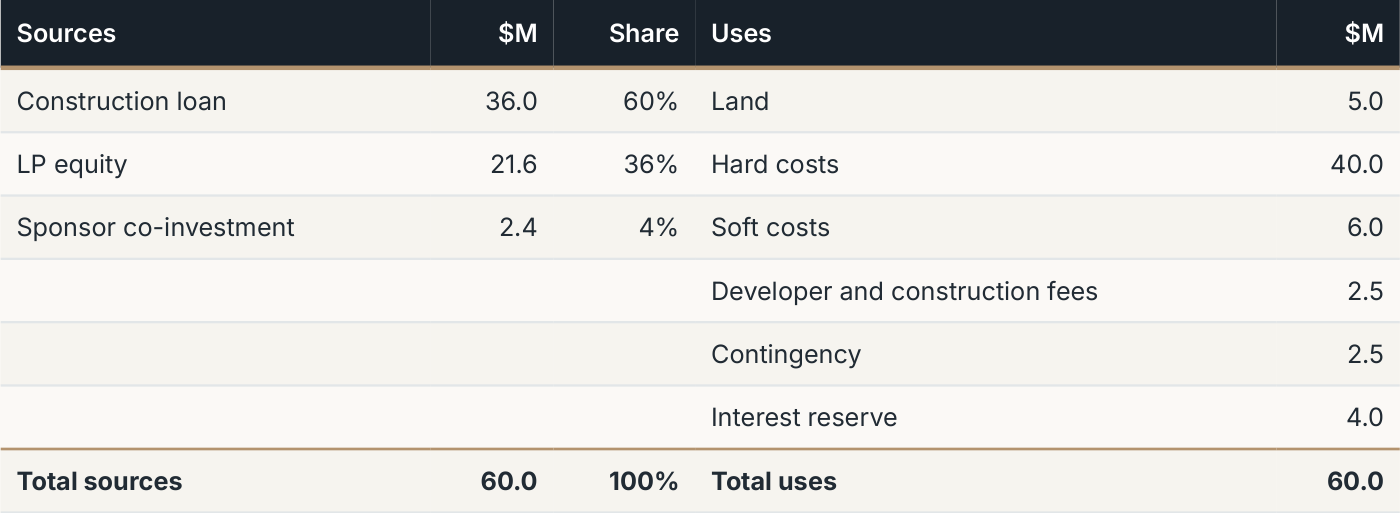
Table Summary and Key Values
| Sources | $M | Share | Uses | $M |
|---|---|---|---|---|
| Construction loan | 36.0 | 60% | Land | 5.0 |
| LP equity | 21.6 | 36% | Hard costs | 40.0 |
| Sponsor co-investment | 2.4 | 4% | Soft costs | 6.0 |
| Developer and construction fees | 2.5 | |||
| Contingency | 2.5 | |||
| Interest reserve | 4.0 | |||
| Total sources | 60.0 | 100% | Total uses | 60.0 |
Sources: 36.0 + 21.6 + 2.4 = 60.0. Uses: 5.0 + 40.0 + 6.0 + 2.5 + 2.5 + 4.0 = 60.0. The two columns balance.
Hypothetical example for illustration only. Not a projection or the terms of any offering.
Sources list where the money comes from: the construction loan, any preferred equity, LP equity and
sponsor equity.
Uses list where it goes: land, hard costs, soft costs, fees, the interest reserve and contingency.
Check that the two columns balance, that every reserve appears as its own line and that sponsor co- investment is shown explicitly. Then read the operating agreement to confirm the rights and priorities of each position match the summary.
Why common equity is where development value accrues
Every layer above common equity has a defined claim: the lender is owed principal and interest, and preferred equity is owed its return and capital. Once those claims are met, everything that remains belongs to common equity. In an acquisition at fair market value, the remaining value depends heavily on rent growth and market pricing. In a development built at a cost below stabilized value, part of that remaining value is created at the outset, through the gap between cost and value.
That is why experienced development investors focus on the quality of the budget, the strength of the reserves and the sponsor's construction capability. These factors protect the value that ultimately belongs to common equity.
The bottom line
The capital stack tells you who gets paid first and who owns the upside. Common equity investors in a ground-up development own the value created by building below fair market value, and they should expect a sponsor to protect that position with co-investment, a disciplined budget and a fully funded interest reserve.
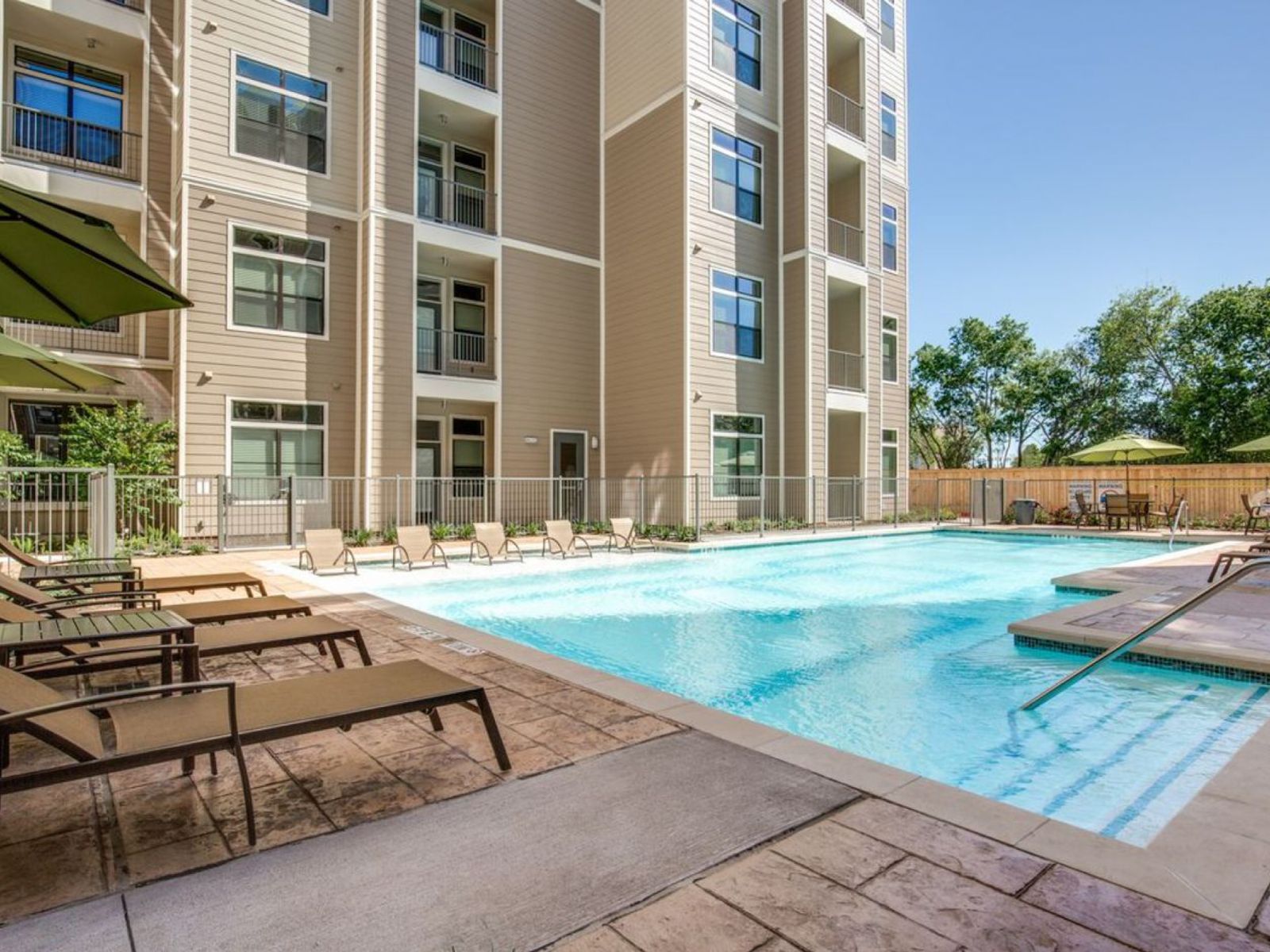
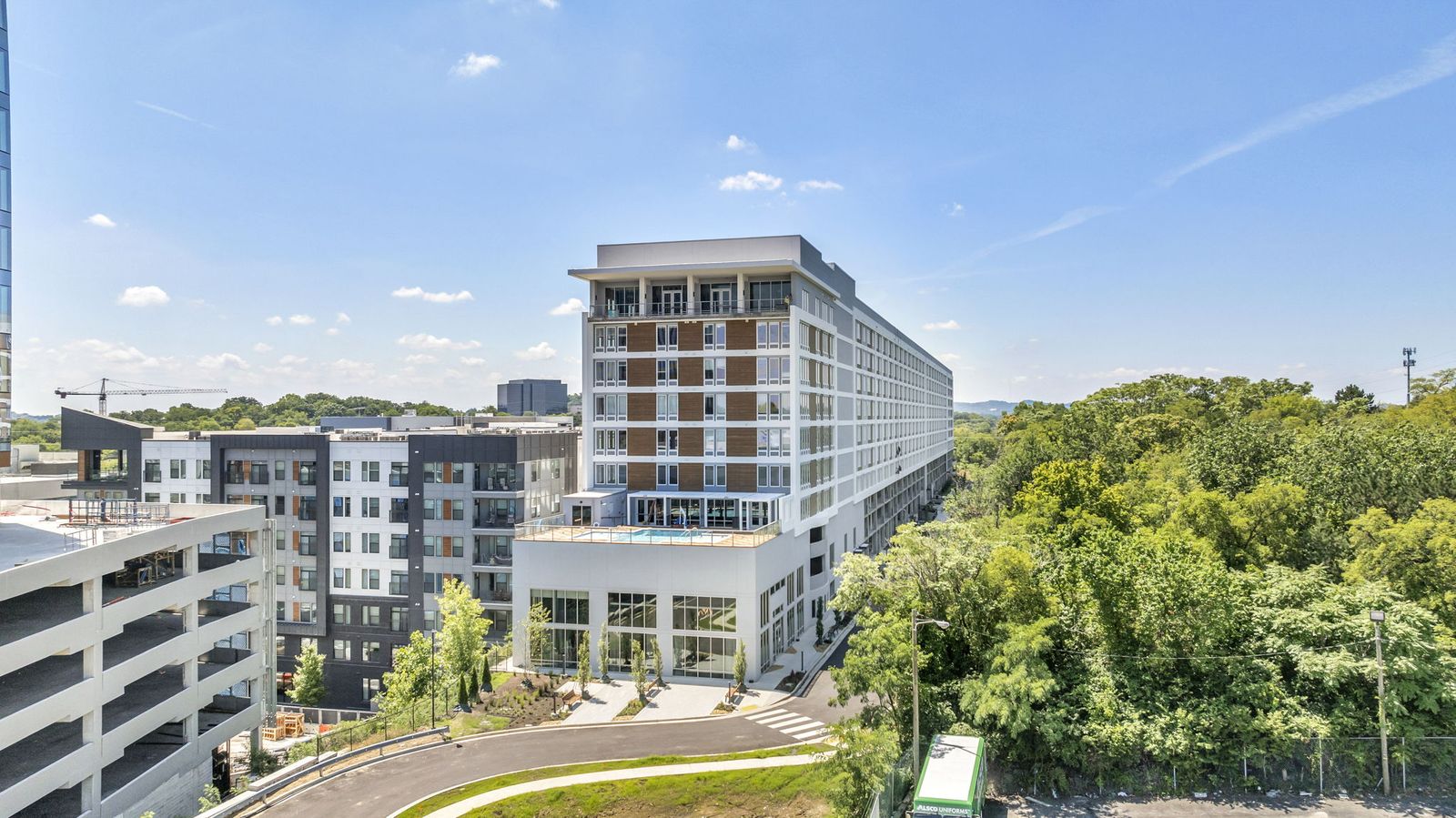
A selection of Ascendant communities

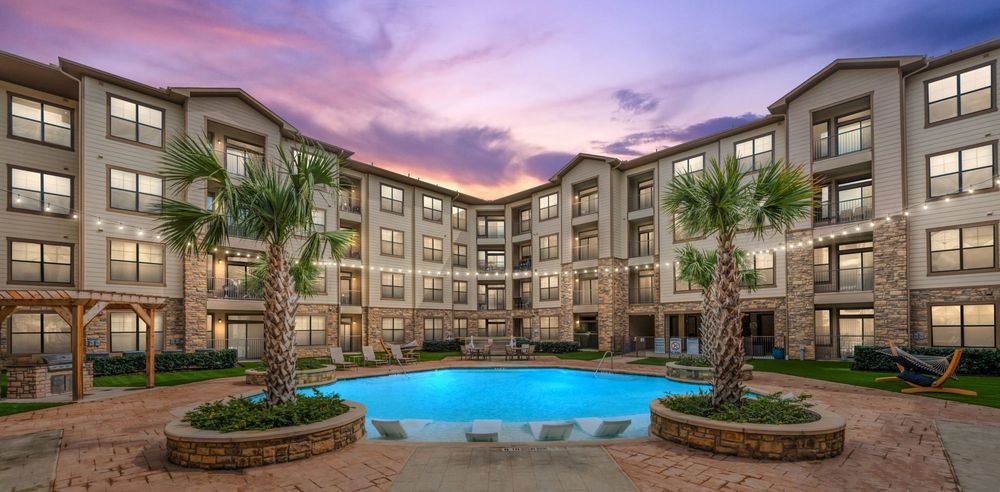
Haven at M, Huntsville, TX · garden Haven at the Gulch, Nashville, TN · high-rise Waterside at Mason, Richmond, TX · mid-rise
Join the Capital Stack Explained Investor List
To talk through development investing with the Ascendant team, visit https:// www.ascendantdevco.com/invest-with-us or call Ascendant Development at 713.600.9393.
Join the Capital Stack Explained Investor List
Sign up for Capital Stack Explained investor updates →
Scan the code to join the Capital Stack Explained Investor List.
S O U R C E S
1. Investor.gov (U.S. Securities and Exchange Commission), "Rule 506 of Regulation D" glossary entry. https://www.investor.gov/ introduction-investing/investing-basics/glossary/rule-506-regulation-d
I M P O R TA N T D I S C L O S U R E S
This article is for educational purposes only and is not an offer to sell or a solicitation of an offer to buy any security. Any offering by Ascendant Development or its affiliates is made only to verified accredited investors under Rule 506(c) of Regulation D through definitive offering documents, which should be read in full, including the risk factors. Real estate development involves risk, including the possible loss of principal, and is illiquid. Nothing here is tax, legal or investment advice; consult your own advisors. Forward-looking statements are not guarantees. Hypothetical examples are for illustration only and are not projections or the terms of any offering. Photographs show completed or existing Ascendant projects. They are shown to illustrate the firm's work and do not represent any specific current offering.
Haven at Main, Houston, Texas.
Haven at Charlotte, Nashville, Tennessee.
For educational purposes only. Not an offer to sell or a solicitation of an offer to buy any security. Any offering will be made only to verified accredited investors under Rule 506(c) of Regulation D through definitive offering documents. Past performance does not guarantee future results.