
Key takeaways from the report
The IRS lets owners of income-producing real estate deduct the cost of a building over its useful life, even though well-located property often holds or gains value.
Depreciation is a non-cash deduction: it reduces taxable income without reducing cash flow.
Not every part of an apartment community is "the building." Components with shorter recovery periods, such as appliances, cabinetry, certain flooring, carpets, specialty electrical and plumbing, and site improvements like parking, landscaping and fencing, can be depreciated over 5, 7 or 15 years.
Depreciation basics
The IRS lets owners of income-producing real estate deduct the cost of a building over its useful life, even though well-located property often holds or gains value. Residential rental buildings are generally depreciated over 27.5 years1. Land is not depreciable.
Depreciation is a non-cash deduction: it reduces taxable income without reducing cash flow. That is a key reason real estate is considered tax-efficient.
What bonus depreciation adds
Not every part of an apartment community is "the building." Components with shorter recovery periods, such as appliances, cabinetry, certain flooring, carpets, specialty electrical and plumbing, and site improvements like parking, landscaping and fencing, can be depreciated over 5, 7 or 15 years.
Bonus depreciation, under Section 168(k) of the Internal Revenue Code, lets owners deduct a percentage of the cost of qualifying shorter-lived property in the year it is placed in service rather than over time1.
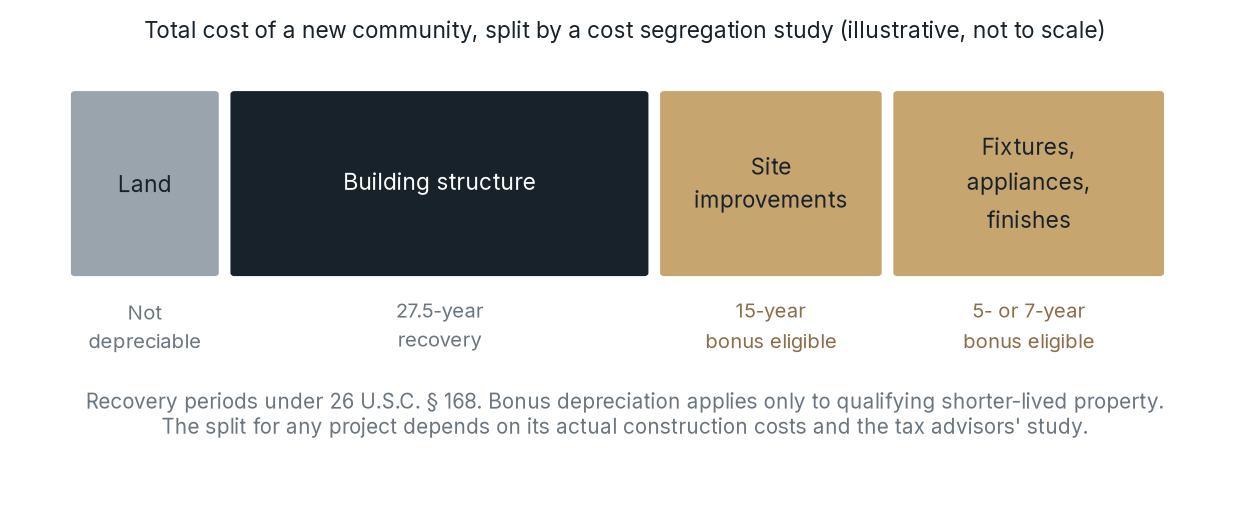
Chart Summary and Key Values
Illustrative cost segregation: land is not depreciable; the residential building structure has a 27.5-year recovery period; qualifying site improvements have a 15-year period; and qualifying fixtures, appliances and finishes have five- or seven-year periods. Bonus depreciation applies only to qualifying shorter-lived property, not the entire building. The blocks are not to scale and actual allocations depend on the study and project costs.
How a cost segregation study can divide a new community's cost. Illustrative proportions; not to scale. Recovery periods per 26 U.S.C. § 168. Graphic: Ascendant Development.
What changed in 2025
Under the 2017 tax law, bonus depreciation was 100% but began phasing down by 20 percentage points a year starting in 2023. The OBBBA (Public Law 119-21) restored 100% bonus depreciation for qualifying property acquired after January 19, 2025, and removed the scheduled phase-down2.
Why it is relevant to new development
A cost segregation study, prepared by engineers and tax specialists, breaks a property's cost into its components and assigns each to the correct recovery period. In a new Class A community, the study is based on actual construction costs, which can make it detailed and well supported.
Because a development places property in service as buildings are completed, the timing of deductions can be planned around the construction and lease-up schedule. Your sponsor's tax advisors determine the approach, and it is reported to you on your K-1.
H Y P OT H E T I CA L I L L U S T R AT I O N : A $ 5 0 M C O M M U N I T Y
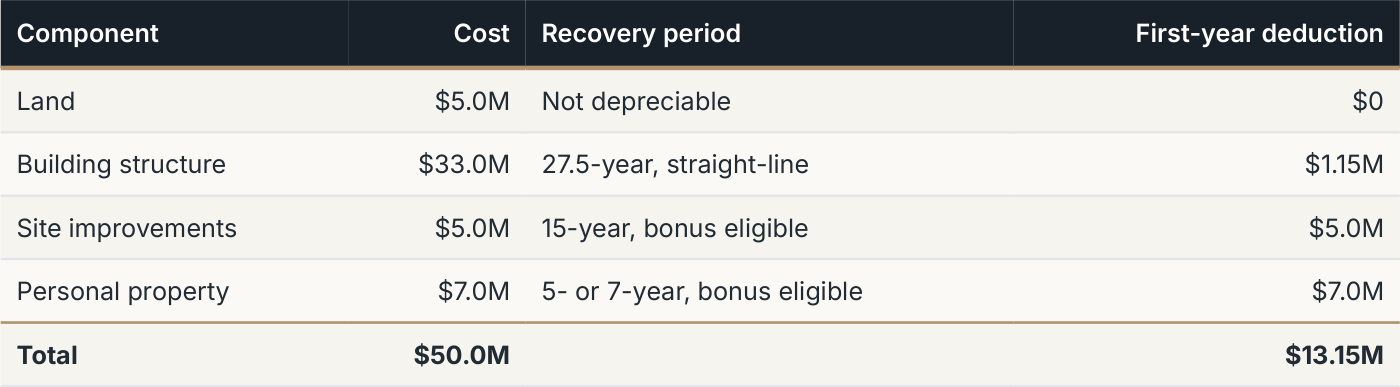
Table Summary and Key Values
| Component | Cost | Recovery period | First-year deduction |
|---|---|---|---|
| Land | $5.0M | Not depreciable | $0 |
| Building structure | $33.0M | 27.5-year, straight-line | $1.15M |
| Site improvements | $5.0M | 15-year, bonus eligible | $5.0M |
| Personal property | $7.0M | 5- or 7-year, bonus eligible | $7.0M |
| Total | $50.0M | $13.15M |
Bonus-eligible: $5.0M + $7.0M = $12.0M, deductible in the first year at 100% bonus depreciation. Structure: $33.0M ÷ 27.5 years = $1.2M per full year. Residential rental property uses the mid-month convention, so property placed in service in January earns 11.5 of 12 months in year one: $1.2M × 11.5 ÷ 12 = $1.15M (the IRS table rate of 3.485% gives $1,150,050). Assumes everything is placed in service in January of the same year. Actual allocations depend on the project's cost segregation study.
Hypothetical example for illustration only. Not a projection or the terms of any offering.
How the deductions reach LP investors
In a partnership or LLC, depreciation is allocated to investors according to the operating agreement and reported on Schedule K-1. What you can do with those deductions depends on your situation:
Passive activity rules. For most investors, losses from a rental real estate partnership are passive. Passive losses generally offset passive income, such as income from other passive investments. Unused passive losses carry forward and can be released when you sell or dispose of your interest.
Real estate professionals. Taxpayers who qualify as real estate professionals under IRS rules, or whose spouses qualify, may be able to treat rental losses as non-passive. The tests are strict.
Depreciation recapture. When a property is sold, prior depreciation may be recaptured and taxed, in part at ordinary income rates for shorter-lived property. Bonus depreciation generally accelerates deductions rather than eliminating tax.
Questions to ask your CPA
1. Do I have passive income these deductions could offset?
2. Do I or my spouse qualify as a real estate professional?
3. How would suspended losses be treated when the property is sold?
4. How does recapture affect my expected tax on exit?
5. Does my state follow federal bonus depreciation rules?
Questions to ask the sponsor
Will the project complete a cost segregation study?
When are buildings expected to be placed in service?
When are K-1s typically delivered each year?
An example of how timing can work
Consider a new multifamily community delivered in phases. As each building receives its certificate of occupancy and is placed in service, the qualifying shorter-lived components in that building become eligible for depreciation. A cost segregation study allocates construction costs among the building, its components and site improvements. The resulting deductions are allocated to investors on their K-1s for the years in which property is placed in service.
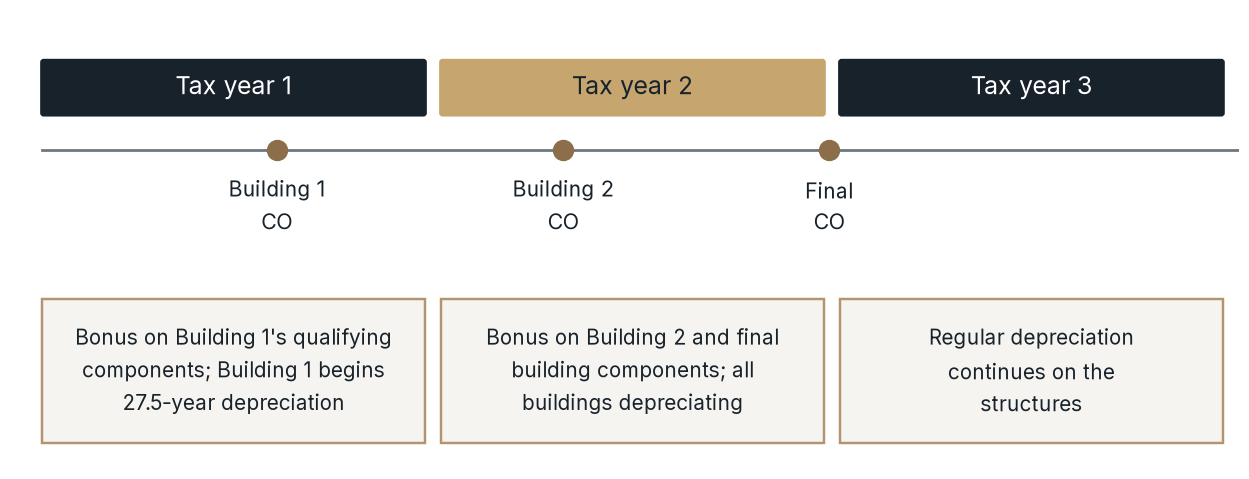
Chart Summary and Key Values
Illustrative phased delivery over three tax years: Building 1 receives its certificate of occupancy in tax year 1 and begins 27.5-year structural depreciation, with bonus depreciation on qualifying components. Building 2 and final building components are placed in service in tax year 2. Regular structural depreciation continues in tax year 3. Tax treatment depends on the actual placed-in-service facts and applicable rules.
Illustrative phased placed-in-service timeline: Building 1 certificate of occupancy (CO), then Building 2, then the final CO, with deductions spread across tax years. Timing varies by project. Graphic: Ascendant Development.
Because development projects place property in service over a construction and lease-up period, deductions may arrive across more than one tax year. Your sponsor's tax advisors can tell you the expected timing, but the actual result depends on construction progress and final cost allocations.
Common misunderstandings
"Bonus depreciation eliminates tax." It generally accelerates deductions. Recapture and gain on sale still apply.
"Everyone can use the losses against wages." Most investors cannot, because of passive activity rules.
"Every dollar of cost qualifies." Only qualifying shorter-lived property is eligible for bonus depreciation. The building itself is depreciated over its normal recovery period, and land is not depreciable.
"State taxes follow federal rules." Many states do not conform to federal bonus depreciation. Texas has no personal income tax, but investors in other states should check whether their state conforms. Ask your CPA.
Frequently asked questions
Does bonus depreciation apply to new apartment buildings themselves? The building structure is
generally depreciated over 27.5 years. Bonus depreciation applies to qualifying shorter-lived components and site improvements identified in a cost segregation study.
Will I receive the deductions in the year I invest? Not necessarily. Deductions follow when property is placed in service, which in a development can be a year or more after closing.
Who decides how depreciation is allocated? The operating agreement sets allocations, and the sponsor's tax preparers report them on your K-1.
The bottom line
The OBBBA made 100% bonus depreciation a lasting feature of real estate investing again. New multifamily development is well suited to cost segregation, and the deductions flow directly to LP investors. Whether they reduce your taxes depends on your own situation, so bring your K-1 questions to a CPA.
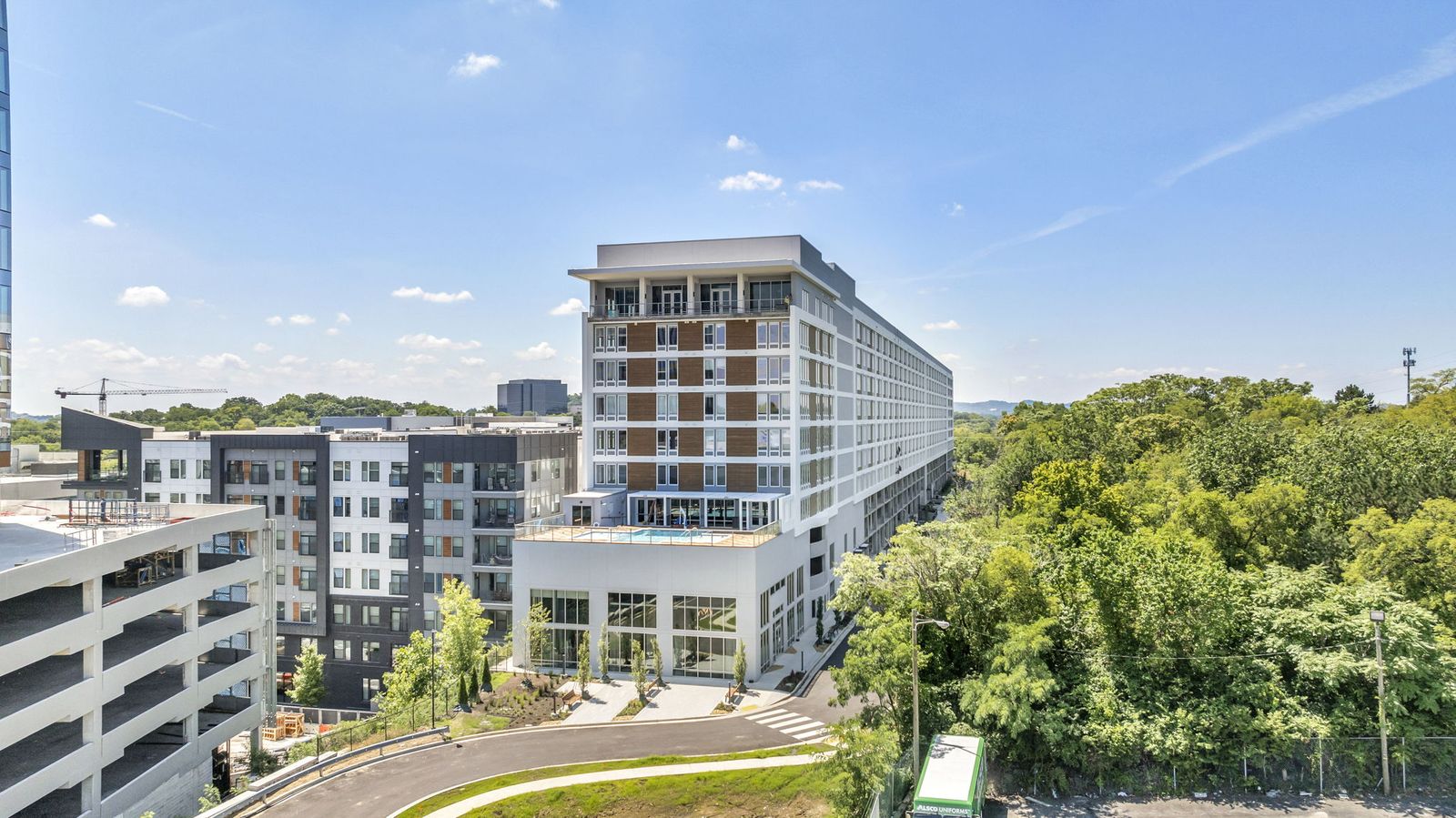
A selection of Ascendant communities
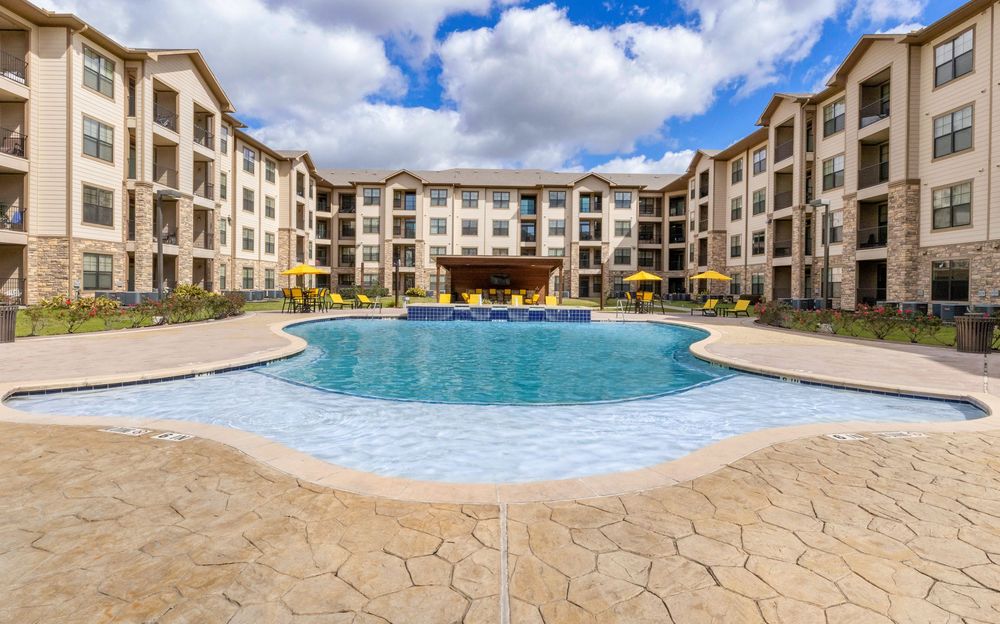
Preserve at HWY 6, Fresno, TX · cottage Haven at the Gulch, Nashville, TN · high-rise Haven at Westheimer, Houston, TX · mid-rise
Join the Bonus Depreciation Investor List
To talk through development investing with the Ascendant team, visit https:// www.ascendantdevco.com/invest-with-us or call Ascendant Development at 713.600.9393.
Join the Bonus Depreciation Investor List
Sign up for Bonus Depreciation investor updates →
Scan the code to join the Bonus Depreciation Investor List.
S O U R C E S
1. Legal Information Institute (Cornell Law School), 26 U.S. Code § 168 (accelerated cost recovery and bonus depreciation). https:// www.law.cornell.edu/uscode/text/26/168
2. Congress.gov, H.R. 1, One Big Beautiful Bill Act (Public Law 119-21). https://www.congress.gov/bill/119th-congress/house-bill/1
I M P O R TA N T D I S C L O S U R E S
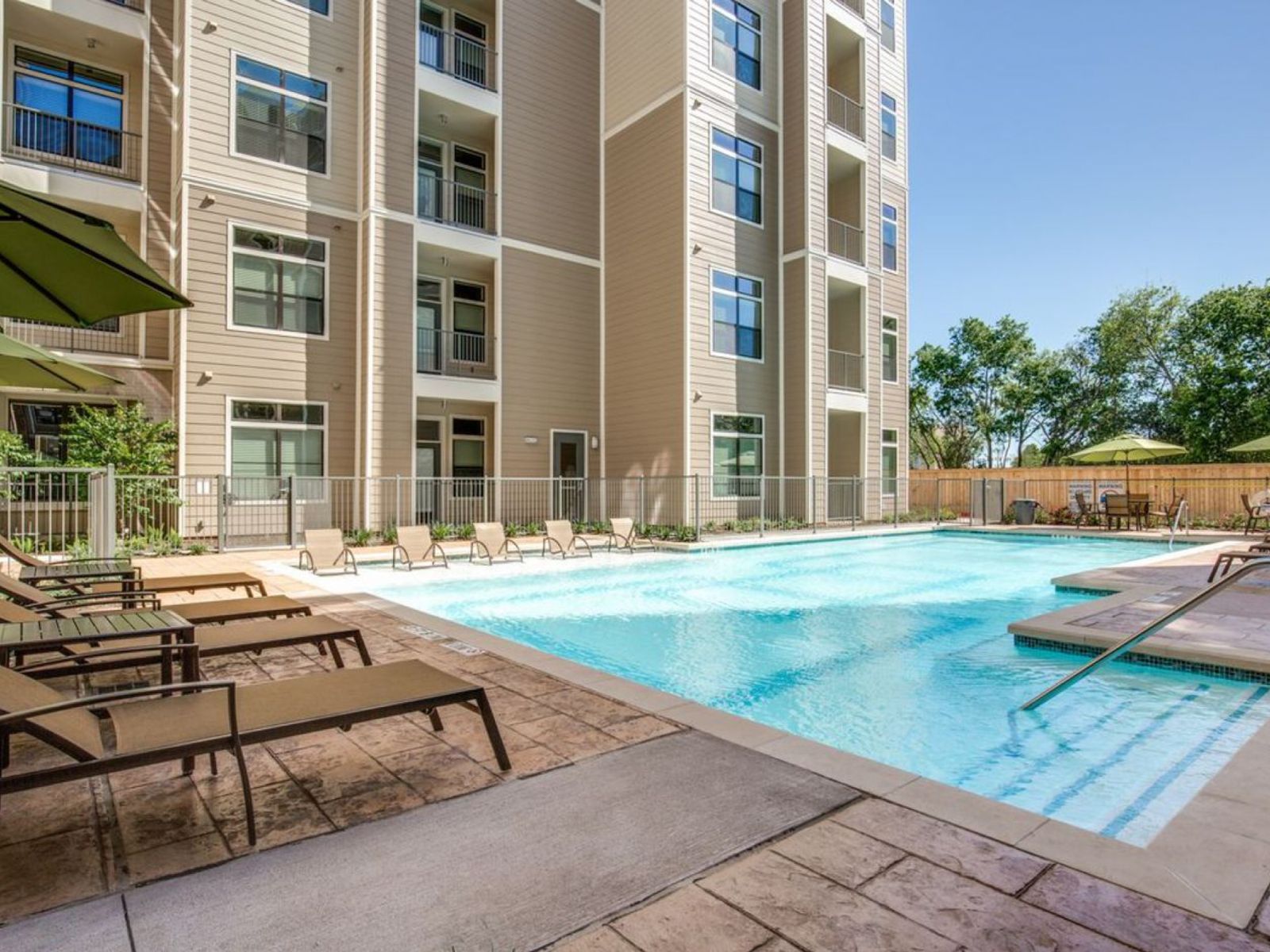
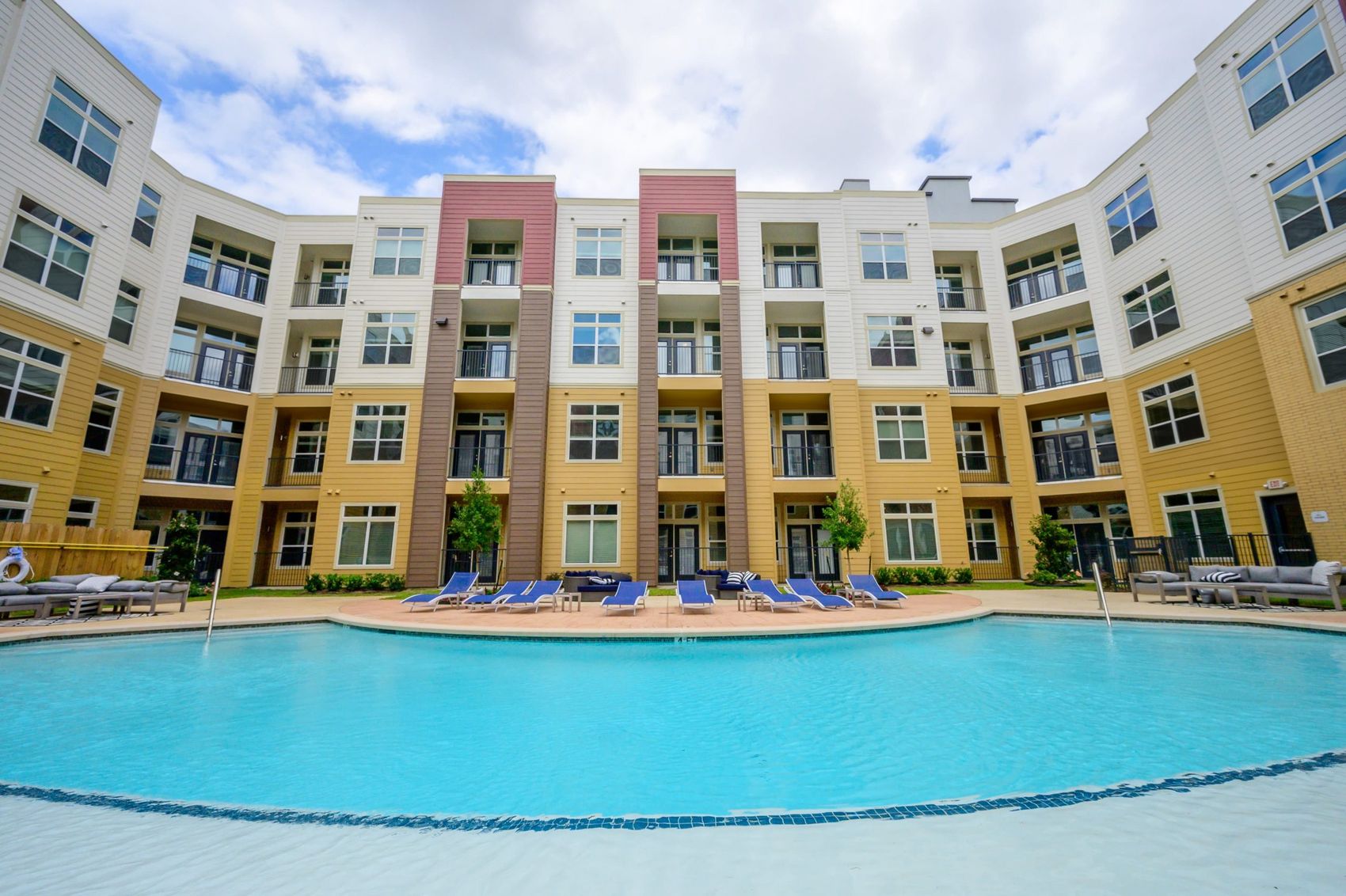
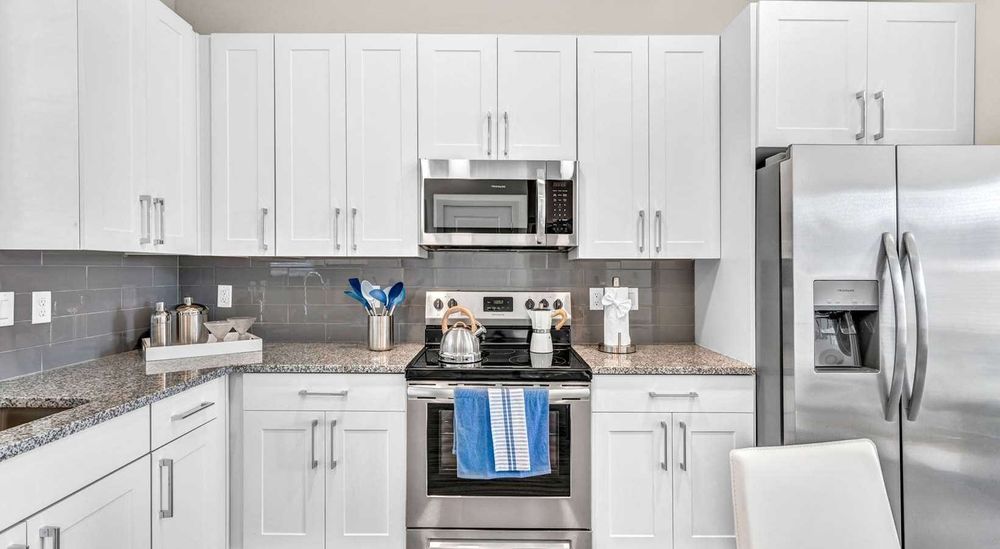
This article is for educational purposes only and is not an offer to sell or a solicitation of an offer to buy any security. Any offering by Ascendant Development or its affiliates is made only to verified accredited investors under Rule 506(c) of Regulation D through definitive offering documents, which should be read in full, including the risk factors. Real estate development involves risk, including the possible loss of principal, and is illiquid. Nothing here is tax, legal or investment advice; consult your own advisors. Forward-looking statements are not guarantees. Hypothetical examples are for illustration only and are not projections or the terms of any offering. Photographs show completed or existing Ascendant projects. They are shown to illustrate the firm's work and do not represent any specific current offering.
Haven at Main, Houston, Texas.
Haven at Charlotte, Nashville, Tennessee.
For educational purposes only. Not an offer to sell or a solicitation of an offer to buy any security. Any offering will be made only to verified accredited investors under Rule 506(c) of Regulation D through definitive offering documents. Past performance does not guarantee future results.