
Key takeaways from the report
Most IRAs at large brokerages are limited to publicly traded investments.
Open an account with an SDIRA custodian and fund it by transfer or rollover from an existing IRA or eligible retirement plan.
Review the offering and confirm with the sponsor that IRA investors are accepted.
What makes an IRA "self-directed"
Most IRAs at large brokerages are limited to publicly traded investments. A self-directed IRA uses a specialized custodian that allows alternative assets, such as private real estate funds and LLC interests. The rules governing what the account can own and how gains are taxed are the same as for any IRA; what differs is the custodian's willingness to hold the asset.
How an SDIRA invests in a private offering
1. Open an account with an SDIRA custodian and fund it by transfer or rollover from an existing IRA or eligible retirement plan.
2. Review the offering and confirm with the sponsor that IRA investors are accepted.
3. Direct the investment. You complete a direction-of-investment form, and the subscription documents are signed in the name of the IRA (for example, "XYZ Trust Company, Custodian FBO Jane Smith IRA").
4. The custodian funds the investment from the IRA's cash.
5. Distributions return to the IRA, not to you personally, and K-1s are issued to the IRA.
Prohibited transactions: the rules that matter most
The tax code bars an IRA from transacting with "disqualified persons," which include you, your spouse, your lineal ascendants and descendants and certain entities you control1. In practice:
You cannot personally use or benefit from property the IRA owns.
You cannot lend to, borrow from or sell assets to your IRA.
You cannot pay IRA expenses from personal funds or route IRA income to yourself.
A prohibited transaction can disqualify the entire IRA, so confirm any arrangement with your custodian and advisors.
UBTI: the tax that can reach an IRA
IRAs are generally tax-exempt, but income from certain activities, called unrelated business taxable income (UBTI), can be taxed inside the account2. Depending on how a real estate partnership is structured and financed, a portion of its income or gain may be treated as UBTI. If an IRA's UBTI exceeds the $1,000 specific deduction, the custodian files Form 990-T and pays the tax from IRA assets2.
H Y P OT H E T I CA L I L L U S T R AT I O N : T H E $ 1 ,0 0 0 S P E C I F I C D E D U C T I O N
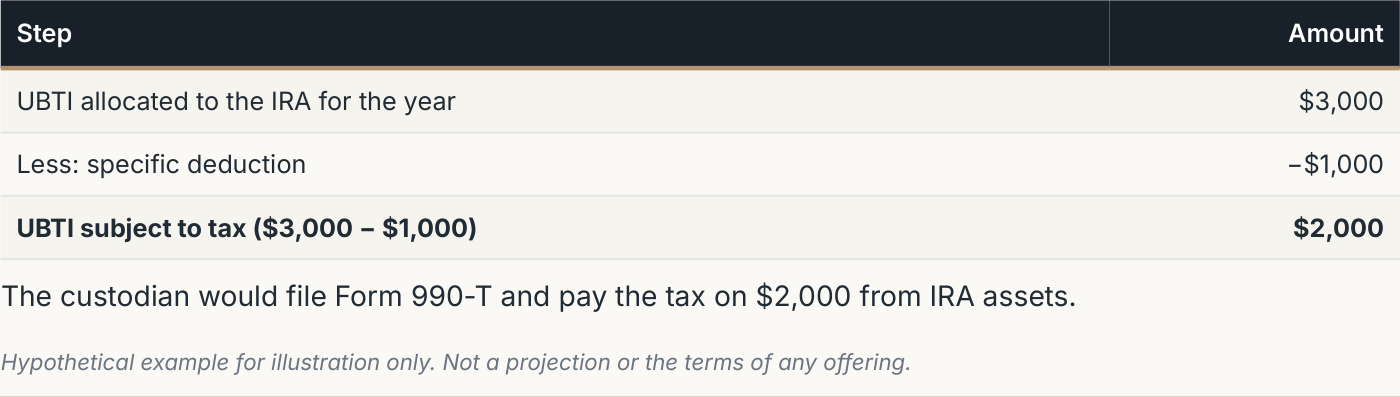
Table Summary and Key Values
| Step | Amount |
|---|---|
| UBTI allocated to the IRA for the year | $3,000 |
| Less: specific deduction | −$1,000 |
| UBTI subject to tax ($3,000 − $1,000) | $2,000 |
| The custodian would file Form 990-T and pay the tax on $2,000 from IRA assets. Hypothetical example for illustration only. Not a projection or the terms of any offering. |
Ask the sponsor whether the investment is expected to generate UBTI, and have your CPA model the effect.
Traditional SDIRA vs. Roth SDIRA
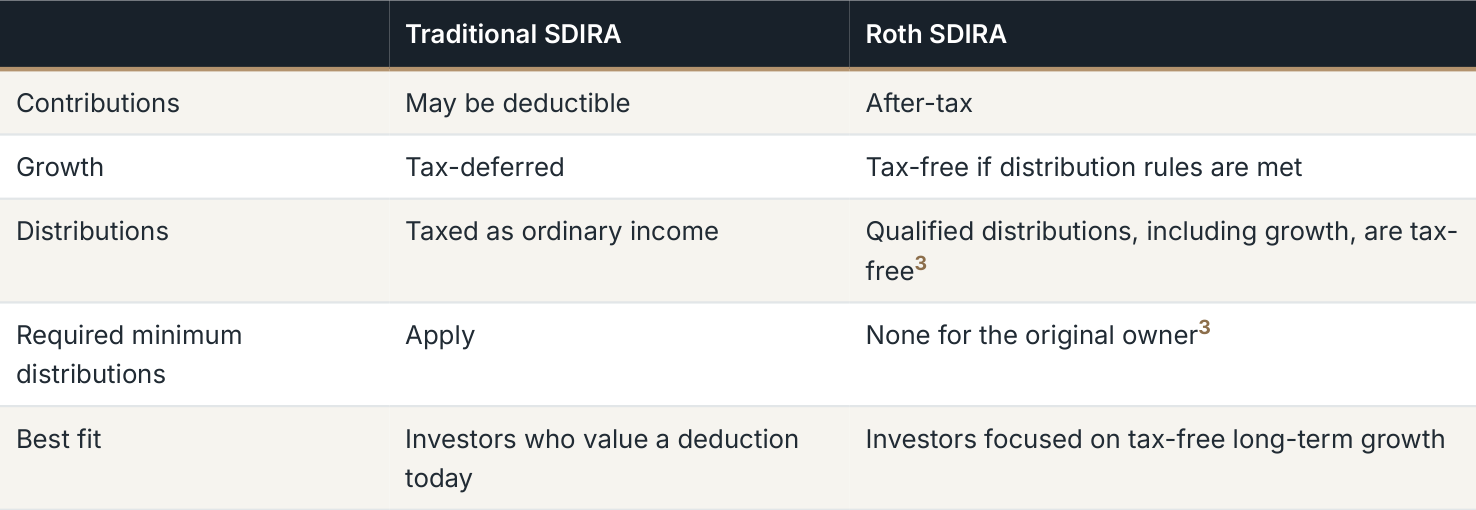
Table Summary and Key Values
| Traditional SDIRA | Roth SDIRA | |
|---|---|---|
| Contributions | May be deductible | After-tax |
| Growth | Tax-deferred | Tax-free if distribution rules are met |
| Distributions | Taxed as ordinary income | Qualified distributions, including growth, are tax- free3 |
| Required minimum distributions | Apply | None for the original owner3 |
| Best fit | Investors who value a deduction today | Investors focused on tax-free long-term growth |
Because private development is a long-horizon investment, some investors prefer to hold it in a Roth account, where growth that is realized at a sale may be tax-free if distribution rules are met. Some investors also explore converting a traditional IRA that holds a private interest to a Roth, paying tax on the interest's appraised value at conversion. Valuation, timing and tax treatment require careful planning with a CPA.
Debt-financed income and Section 514
Section 514 of the tax code treats part of the income from "debt-financed property" as UBTI. In general terms, when a partnership uses borrowed money to acquire or improve property, a share of the income and gain from that property, roughly in proportion to the debt relative to the property's basis, can be taxable UBTI for an IRA that invests in the partnership4. The calculation involves averaging rules and exceptions, and whether it applies depends on how each investment is structured. Refer the offering documents to your CPA to estimate any effect before you invest.
Practical tips
Keep cash in the account for custodian fees and any 990-T tax.
Mind the paperwork timeline; custodians may need several days to process a direction of investment.
Understand illiquidity. If you are near required-distribution age, plan how distributions will be met while the private interest is held.
Use the right entity name on every document.
Questions to ask your custodian
Fees: What are the setup, annual, per-asset and transaction fees for holding a private investment?
Processing time: How long does it take to process a direction of investment and fund an alternative asset?
Form 990-T handling: If the investment generates UBTI, who prepares and files Form 990-T, and how is the tax paid from the account?
Valuation reporting: How and when must the private interest be valued for year-end reporting, and what will you need from the sponsor?
Is an SDIRA right for a development investment?
An SDIRA can be a good fit when:
You have meaningful retirement assets and want exposure to private real estate
Your time horizon matches the expected hold period of the investment
You are comfortable with custodian fees and paperwork
Your CPA has reviewed the potential UBTI and any Form 990-T obligations
It may be a weaker fit when:
You will need distributions from the account during the expected hold period
You would benefit more from depreciation deductions in a taxable account
The added fees outweigh the tax benefits for the size of the investment
Depreciation in a retirement account
Depreciation deductions that flow through a K-1 to an IRA generally do not provide current tax benefits to you personally, because the IRA's investment income is already tax-deferred or tax-free. Investors who value depreciation deductions often hold development interests in taxable accounts, while investors focused on tax-free long-term growth may prefer a Roth. A CPA can help you decide which account fits your goals.
Frequently asked questions
Can I invest from a 401(k)? Most employer plans do not allow private investments, but funds from a former employer's plan can often be rolled into an SDIRA. Ask your plan administrator and custodian.
Who signs the subscription documents? You complete them as the account owner directing the investment, and the custodian signs on behalf of the IRA.
Can my spouse's IRA and mine invest together? Each IRA invests separately in its own name, with its own documents.
The bottom line
A self-directed IRA or Roth IRA can be an efficient way to own a share of a new multifamily development, but it carries rules that taxable accounts do not. Get your custodian, CPA and sponsor aligned before you invest.
A selection of Ascendant communities
Haven at Bellaire, Richmond, TX · garden Haven at Elgin, Houston, TX · high-rise Haven at Liberty Hills, Houston, TX · mid-rise
Join the Self-Directed IRA and Roth IRA Investor List
To talk through development investing with the Ascendant team, visit https:// www.ascendantdevco.com/invest-with-us or call Ascendant Development at 713.600.9393.
Join the Self-Directed IRA and Roth IRA Investor List
Sign up for Self-Directed IRA and Roth IRA investor updates →
Scan the code to join the Self-Directed IRA and Roth IRA Investor List.
S O U R C E S
1. Legal Information Institute (Cornell Law School), 26 U.S. Code § 4975 (prohibited transactions). https://www.law.cornell.edu/uscode/text/ 26/4975
2. Legal Information Institute (Cornell Law School), 26 U.S. Code § 512 (unrelated business taxable income). https://www.law.cornell.edu/ uscode/text/26/512
3. Legal Information Institute (Cornell Law School), 26 U.S. Code § 408A (Roth IRAs). https://www.law.cornell.edu/uscode/text/26/408A
4. Legal Information Institute (Cornell Law School), 26 U.S. Code § 514 (unrelated debt-financed income). https://www.law.cornell.edu/ uscode/text/26/514

I M P O R TA N T D I S C L O S U R E S
This article is for educational purposes only and is not an offer to sell or a solicitation of an offer to buy any security. Any offering by Ascendant Development or its affiliates is made only to verified accredited investors under Rule 506(c) of Regulation D through definitive offering documents, which should be read in full, including the risk factors. Real estate development involves risk, including the possible loss of principal, and is illiquid. Nothing here is tax, legal or investment advice; consult your own advisors. Forward-looking statements are not guarantees. Hypothetical examples are for illustration only and are not projections or the terms of any offering. Photographs show completed or existing Ascendant projects. They are shown to illustrate the firm's work and do not represent any specific current offering.

Haven at Main, Houston, Texas.
Haven at Charlotte, Nashville, Tennessee.
- Source 1 on report page 6
- Source 2 on report page 6
- Source 3 on report page 6
- Source 4 on report page 6
For educational purposes only. Not an offer to sell or a solicitation of an offer to buy any security. Any offering will be made only to verified accredited investors under Rule 506(c) of Regulation D through definitive offering documents. Past performance does not guarantee future results.