
Key takeaways from the report
Most private real estate offerings are not registered with the SEC.
Sponsors may only offer to people with whom they have a pre- existing relationship, and up to 35 non-accredited but sophisticated investors may participate.
In exchange, every purchaser must be accredited, and the sponsor must take reasonable steps to verify that status.
Private offerings and Regulation D
Most private real estate offerings are not registered with the SEC. They rely on exemptions in Regulation D. The two most common are Rule 506(b) and Rule 506(c)1.
506(b) prohibits general solicitation. Sponsors may only offer to people with whom they have a pre- existing relationship, and up to 35 non-accredited but sophisticated investors may participate. Investors can generally self-certify their accredited status.
506(c) allows general solicitation, which means sponsors can talk about their offerings publicly, including on websites, at events and in the media. In exchange, every purchaser must be accredited, and the sponsor must take reasonable steps to verify that status.
That is why you can read about Ascendant's investment approach openly, and why we ask for verification before accepting an investment.
Who is an accredited investor?
The SEC's definition in Rule 501(a) includes several paths for individuals2,3:
Net worth: individual or joint net worth with a spouse or spousal equivalent above $1 million, excluding the value of a primary residence
Income: individual income above $200,000, or joint income above $300,000, in each of the two most recent years, with a reasonable expectation of the same in the current year
Professional credentials: holders in good standing of certain FINRA licenses (Series 7, 65 or 82)
Knowledgeable employees of certain private funds
Entities can also qualify, for example trusts and companies above certain asset thresholds or entities whose owners are all accredited. The full list is in the regulation.
What "reasonable steps to verify" looks like
The SEC rule lists non-exclusive methods for verifying individuals1:
1. Third-party confirmation. A written confirmation from a registered broker-dealer, SEC-registered investment adviser, licensed attorney or CPA that they have taken reasonable steps to verify your status within the prior three months.
2. Income review. Reviewing IRS forms that report income, such as W-2s, 1099s, K-1s or tax returns, for the two most recent years, plus a written representation about the current year.
3. Net worth review. Reviewing recent statements of assets (bank, brokerage, appraisal reports) and a credit report for liabilities, plus a written representation.
4. Prior verification. In some cases, reliance on a prior verification by the same issuer for an existing investor.
Many investors find the simplest path is a short letter from their CPA or attorney, or an online third-party verification service.
2025 SEC staff guidance on minimum investments. In March 2025, SEC staff issued a no-action letter indicating that a high minimum investment can be a reasonable verification step. Under that guidance, a minimum investment of at least $200,000 for individuals or $1,000,000 for entities, together with written representations from the investor that it is accredited and that the minimum is not financed by a third party for the purpose of investing, and with no actual knowledge to the contrary on the issuer's part, may satisfy the reasonable-steps requirement4,5. Not every sponsor uses this approach, so confirm with the sponsor which verification methods it accepts.
What the process looks like with a sponsor
1. Introductory call. You learn about the sponsor and the offering.
2. Review the documents. You receive the PPM, operating agreement and subscription agreement.
3. Subscribe. You complete the subscription documents, including your investing entity information.
4. Verify. You provide a verification letter or complete a third-party verification.
5. Fund. Once your subscription is accepted, you wire funds per the instructions in your documents. Always confirm wiring instructions by phone with a known contact.
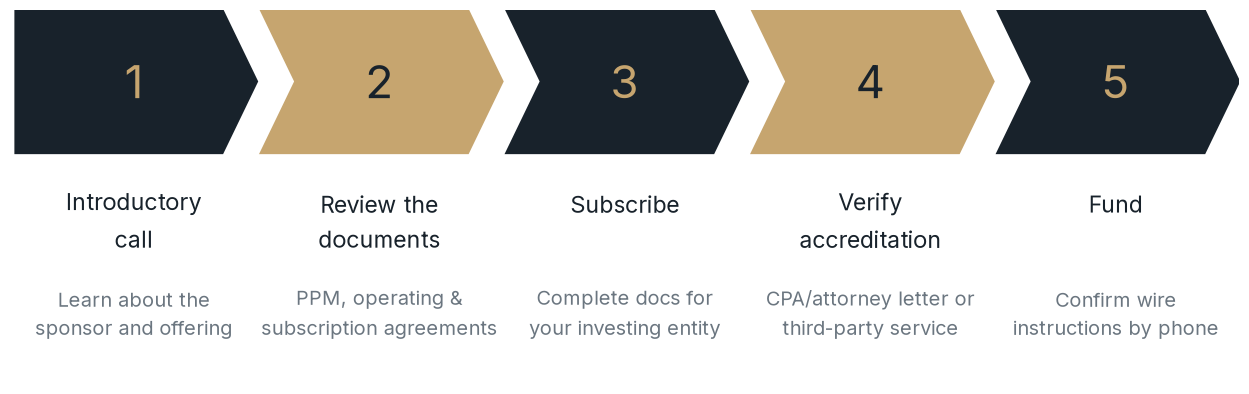
Chart Summary and Key Values
The five illustrated investor onboarding steps are introductory call; review the PPM, operating agreement and subscription documents; subscribe for the intended investing entity; verify accreditation through an appropriate professional or third party; and fund. The final step advises confirming wire instructions by phone. This is an illustrative process, not an open securities offering.
A typical path from first call to funding in a 506(c) offering. Steps vary by sponsor. Graphic: Ascendant Development.
Common questions
Do I need to verify for every investment?
Verification is generally done per offering, and third-party letters typically need to be recent. Ask the sponsor what they accept.
Will my information be kept private?
Ask how the sponsor and any verification provider store your documents. A letter from your own CPA or attorney means you share less documentation directly.
Can I invest through an LLC, trust or IRA?
Often yes. The entity itself must qualify or be verified, and the subscription documents will be completed in the entity's name.
Why sponsors use 506(c)
Rule 506(c) allows sponsors to publish educational content, speak at events and share information about their approach openly. For investors, that transparency is valuable: you can learn about a sponsor's track record, completed properties and thinking long before you are asked to invest. The verification step is the trade-off that keeps offerings limited to investors who meet the SEC's financial thresholds.
Tips for a smooth verification
Ask your CPA or attorney early. Many professionals are familiar with accredited investor verification letters and can turn them around quickly once they know what is needed.
Use the right entity. If you plan to invest through an LLC, trust or IRA, make sure the verification addresses that entity.
Mind the timing. Third-party confirmations are generally relied on only if they are recent, so verify close to the time you subscribe.
Keep a copy. If you invest with the same sponsor again, ask whether a prior verification can be updated rather than repeated.
Protect your data. Share sensitive financial documents only through secure channels the sponsor or verification service provides.
Frequently asked questions
Does a higher income in only one year qualify? Generally no. The income test looks at the two most recent years plus a reasonable expectation for the current year.
Does home equity count toward the $1 million net worth test? The value of a primary residence is excluded, and related mortgage rules are set out in the regulation. Your CPA or attorney can confirm how they apply to you.
Is verification a judgment on my suitability? No. It confirms that you meet the SEC's definition. Whether an investment suits your goals is a separate decision.
The bottom line
Rule 506(c) lets sponsors share their story openly while keeping offerings limited to accredited investors. Verification is a short, standard step, and knowing what to expect makes it painless.
A selection of Ascendant communities


Waterside at Mason, Richmond, TX · mid-rise Haven at M, Huntsville, TX · garden Haven at Charlotte, Nashville, TN · high-rise
Join the Rule 506(c) and Accredited Investor Verification Investor List
To talk through development investing with the Ascendant team, visit https:// www.ascendantdevco.com/invest-with-us or call Ascendant Development at 713.600.9393.
Join the Rule 506(c) and Accredited Investor Verification Investor List
Sign up for Rule 506(c) and Accredited Investor Verification investor updates →
Scan the code to join the Rule 506(c) and Accredited Investor Verification Investor List.
S O U R C E S
1. Electronic Code of Federal Regulations, 17 CFR 230.506 (Rule 506(b) and 506(c), including verification methods). https://www.ecfr.gov/ current/title-17/section-230.506
2. Electronic Code of Federal Regulations, 17 CFR 230.501(a) (accredited investor definition). https://www.ecfr.gov/current/title-17/ section-230.501
3. Investor.gov (U.S. SEC), "Accredited Investors" glossary entry. https://www.investor.gov/introduction-investing/investing-basics/ glossary/accredited-investors
4. U.S. Securities and Exchange Commission, Division of Corporation Finance, no-action letter to Latham & Watkins LLP regarding Rule

506(c) verification (March 12, 2025). https://www.sec.gov/rules-regulations/no-action-interpretive-exemptive-letters/division- corporation-finance-no-action/latham-watkins-503c-031225
5. Latham & Watkins LLP, incoming no-action request to the SEC Division of Corporation Finance (March 2025). https://www.sec.gov/files/ corpfin/no-action/latham-watkins506c-031225-incoming.pdf
I M P O R TA N T D I S C L O S U R E S
This article is for educational purposes only and is not an offer to sell or a solicitation of an offer to buy any security. Any offering by Ascendant Development or its affiliates is made only to verified accredited investors under Rule 506(c) of Regulation D through definitive offering documents, which should be read in full, including the risk factors. Real estate development involves risk, including the possible loss of principal, and is illiquid. Nothing here is tax, legal or investment advice; consult your own advisors. Forward-looking statements are not guarantees. Hypothetical examples are for illustration only and are not projections or the terms of any offering. Photographs show completed or existing Ascendant projects. They are shown to illustrate the firm's work and do not represent any specific current offering.
Haven at the Gulch, Nashville, Tennessee.
- Source 1 on report page 5
- Source 2 on report page 5
- Source 3 on report page 5
- Source 4 on report page 5
- Source 5 on report page 5
- Source 6 on report page 5
- Source 7 on report page 5
- Source 8 on report page 5
Frequently asked questions
Who is an accredited investor?
The SEC's definition in Rule 501(a) includes several paths for individuals2,3: Net worth: individual or joint net worth with a spouse or spousal equivalent above $1 million, excluding the value of a primary residence Income: individual income above $200,000, or joint income above $300,000, in each of the two most recent years, with a reasonable expectation of the same in the current year Professional credentials: holders in good standing of certain FINRA licenses (Series 7, 65 or 82) Knowledgeable employees of certain private funds Entities can also qualify, for example trusts and companies above certain asset thresholds or entities whose owners are all accredited. The full list is in the regulation.
Do I need to verify for every investment?
Verification is generally done per offering, and third-party letters typically need to be recent. Ask the sponsor what they accept.
Will my information be kept private?
Ask how the sponsor and any verification provider store your documents. A letter from your own CPA or attorney means you share less documentation directly.
Can I invest through an LLC, trust or IRA?
Often yes. The entity itself must qualify or be verified, and the subscription documents will be completed in the entity's name.
For educational purposes only. Not an offer to sell or a solicitation of an offer to buy any security. Any offering will be made only to verified accredited investors under Rule 506(c) of Regulation D through definitive offering documents. Past performance does not guarantee future results.